
Jump to content

HenryJames

Certifiably Surly
  • Posts

    32328
  • Joined

  • Days Won

    100

Posts posted by HenryJames

  1. Elon Musk Didn’t Want His Latest Deposition Released. Here It Is.

    Musk is being sued for falsely suggesting a 22-year-old Jewish man was part of a neo-Nazi brawl.
     
    SpoilerSebastian MurdockApr 8, 2024, 01:00 PM EDT
     

    Elon Musk sat for a two-hour deposition to answer questions about his role in amplifying a false conspiracy that accused a 22-year-old Jewish man of being involved in a neo-Nazi brawl. It did not go well for Musk.


    Elon Musk sat for a two-hour deposition to answer questions about his role in amplifying a false conspiracy that accused a 22-year-old Jewish man of being involved in a neo-Nazi brawl. It did not go well for Musk.

    Illustration:Jianan Liu/HuffPost; Photo:Getty Images

    Elon Musk was deposed last month over his role in allegedly promoting a false conspiracy theory that a 22-year-old Jewish man participated in a neo-Nazi brawl. 

    Musk tried to keep the deposition from going public, and perhaps for good reason: It did not go well for him.

    “There’s some risk that what I say is incorrect, but one has to balance that against having a chilling effect on free speech in general, which would undermine the entire foundation of our democracy,” Musk, the owner of X (formerly Twitter), said during the deposition.

    The lawsuit against the billionaire, filed in October, alleges that Musk used his colossal social media platform to amplify a false far-right conspiracy theory linking 22-year-old Ben Brody to a brawl in Oregon between the neo-Nazi group Rose City Nationalists and the Proud Boys, a neo-fascist fight club. The brawl occurred during Oregon City’s first Pride Night Fest, when both groups came to disrupt the event and spew anti-LGBTQ+ rhetoric.

    Brody wasn’t even in the same state when the June 24 brawl occurred. But his world was turned upside down when far-right X accounts, magnified by Musk, falsely identified him as a member of Rose City Nationalists (and an undercover federal agent) and posted his personal information online.

    Musk amplified the conspiracy theory repeatedly to his more than 180 million followers, suggesting Brody was a fresh-faced federal agent pretending to be a neo-Nazi in a “false flag situation,” a phrase used to suggest a harmful event was deliberately set up to misrepresent a group or person.

    “Looks like one is a college student (who wants to join the govt) and another is maybe an Antifa member, but nonetheless a probable false flag situation,” Musk posted to X after Brody had been falsely identified as a Rose City Nationalists member. The post remains on X.

    Brody said he and his family were forced to flee their home amid the fallout from Musk’s posts. He’s seeking more than $1 million in damages. The next court hearing is scheduled for April 22.

    On March 27, Musk sat for a two-hour deposition with attorneys from both parties over Zoom. Following the testimony, Musk’s lawyer, Alex Spiro, filed multiple emergency motions in an attempt to keep the deposition sealed.

    “I’m asking that this transcript be marked as confidential,” Spiro said at the end of Musk’s deposition, according to the transcript. “That’s what I’m asking for, OK?”

    Spiro’s efforts failed after a judge struck down his motions. Though video of the deposition has not been made public, HuffPost obtained a copy of the full transcript, which was made public Monday.

    During his deposition, Musk admitted he has a “limited understanding” of the lawsuit against him, said he thought Brody’s attorney was the one suing him, and revealed he did no research in determining whether Brody was involved in the brawl after seeing the accusations on X. 

    Musk also made broader admissions about his failures with X — which has plummeted in value since his takeover in 2022 — saying he “may have done more to financially impair” the social media site than help it. Musk also confirmed that heonce used a burner account on Xseemingly to role-play as his toddler son.

    “I’m guilty of many self-inflicted wounds,” Musk testified.


    ‘Actually, Mr. Musk, I’m An Attorney. Did You Know That?’


    From the outset of the deposition, Spiro traded barbs with Brody’s attorney, Mark Bankston, as Musk attempted to answer basic questions about the case.

    “Do you think you did anything wrong to Ben Brody?” asked Bankston, who’s based in Houston.

    Spiro interjected, saying this “isn’t a question you’re allowed to ask by the court.”

    It was the start of what would be a contentious back-and-forth between two high-profile attorneys. Spiro, who has represented celebrities such as Jay-Z and Megan Thee Stallion, previously won a defamation case for Musk after the billionaire called a man who helped rescue children trapped in a cave in Thailand a “pedo guy” in 2018.

    “You keep filing these silly, frivolous shake-down cases, I’ll keep trying to think of Texas lawyers to bring to your depositions,” Spiro told Bankston. 

    Bankston, of the Texas law firm Farrar & Ball, previously represented two Sandy Hook parents who won $45 million in damages against conspiracy theorist Alex Jones after Jones spent years falsely claiming the 2012 school shooting never happened.

    Spiro did not respond to a request for comment on this story. Bankston declined to comment.

    Throughout his testimony, Musk showed little understanding about the lawsuit he was testifying for, and even said he believed it was Bankston — not Brody — who was suing him.

    “I think you’re the one suing,” Musk told Bankston, according to the transcript.

    “Actually, Mr. Musk, I’m an attorney,” Bankston explained. “Did you know that? I’m an attorney representing Mr. Brody.”

    Asked if Musk understood what the lawsuit was about, Musk admitted he had “a limited understanding of that — of what the lawsuit is about” but suggested again that this was simply a money grab by Brody’s attorney.

    “My — what I want to think it’s really about is about you getting a lot of money,” said Musk, who paid $44 billion for Twitter in 2022.


    From An Anti-Semitic Account To Elon Musk


    Musk learned of the conspiracy theory about Brody from what the lawsuit describes as a fringe X account with more than 30,000 followers that “features extreme rightwing memes, neo-Nazi apologia/nostalgia, juvenile and cringe-worthy attempts at bigoted humor, low effort bait tweets, delusional panics over lazy hoaxes, and a cavalcade of absurdly false information.”

    “The account is the social media equivalent of gutter sludge,” the lawsuit says.

    The anonymous account, named Dr Frensor, posted a photo of Brody with his personal information found on his college fraternity’s social media page. The caption on the photo of Brody read, “After graduation he plans to work for the government,” which Dr Frensor used to suggest Brody was at the brawl and a federal plant.

    “Very odd,” Musk responded. As it goes whenever Musk interacts with a post on X, this one quickly went viral.

    In his deposition, Musk was asked whether he’d seen other posts from the Dr Frensor account.

    “I wasn’t trying to assess their credibility,” Musk responded. 

    Bankston showed Musk a meme Dr Frensor had posted the same day the account posted about Brody. More from the transcript:

    Bankston: And here it says at the top, ‘Is this meme insensitive to Jewish persons?’ And then there’s a meme of the United Nations’ logo that says, “Founded in 1945 to end all wars, the United Nations. The world has been at war ever since.’ Do you know if you saw this? 

    Musk: I have not seen this.

    B: Okay. Would this have triggered a red flag as to this person’s credibility?

    Spiro: Objection to form.

    M: I mean, I think it’s a dubious post, but it suggests anti-Semitism. 

    B: Correct. … I think we all know it reflects anti-Semitism. I’m asking, does this trigger red flags to this person’s reliability?

    M: I would say, yes, it probably does.

    Still, Musk defended his response to the anti-Semitic account.

    “But if you’re suggesting that in order to reply to anyone, you have to scroll through all their posts, that would make it impossible to use the system,” he said of his website.


    A Billionaire’s Fact-Checking Process


    Contrary to his earlier statements, Musk suggested later on in the deposition that he researches discourse before he joins it.

    “If you care about the truth, you have to go look about it,” Musk said. 

    Musk’s own testimony reveals he did little to seek out the truth.

    “Would it be fair for me to say that, other than the tweets that you interacted with, you did not secure other information about this unmasked brawler?” Bankston asked at one point.

    “I don’t recall securing other information,” Musk responded.

    During his testimony, Musk criticized what he called the “traditional legacy news industry” while lauding X’s Community Notes, a website tool that allows users to add corrections or additional context to misleading or untrue posts.

    Musk called Community Notes “the best system on the internet” for fact-checking, and said he tagged Community Notes in his post referencing Brody as a show of “good faith,” the transcript shows.

    “And I think — I think I really did this in good faith, because I would not ask for a fact-check which is what I do by adding Community Notes,” Musk said, according to the transcript.

    Musk did tag Community Notes in his post about Brody, but a note was never added to the false claim. The post remains on X today without a correction. 

    Musk was also asked about his interactions with posts on X, which can make an otherwise invisible post go instantly viral. Bankston pointed out that his post on X referring to a “college student who wants to join the govt” was seen more than a million times, according to X’s metrics. 

    Musk downplayed the number and argued that his post was merely a reply to someone else, which attracted less viewership than his own post would.

    Bankston: You do understand that the amount of people who saw this, who have viewed this, is equivalent to all 30 major league baseball stadiums filled to capacity? You wouldn’t dispute that? I mean, we’re talking over a million people.

    Spiro: Objection to form.

    Musk: Yeah, that’s actually – that may seem like a large number, but it is not compared to the fact – I believe there are something on the order of five to eight trillion views per year so a million is really –

    B: Not a big deal?

    M: – hit or miss, yeah.

    B: Not a big deal that this went out to that many people?

    M: Correct. 


    Elon Musk is being sued for defamation after falsely accusing a recent college graduate of being a neo-Nazi (featured on the left) that was unmasked during an Oregon Pride event that was disrupted by Proud Boys and neo-Nazis.


    Elon Musk is being sued for defamation after falsely accusing a recent college graduate of being a neo-Nazi (featured on the left) that was unmasked during an Oregon Pride event that was disrupted by Proud Boys and neo-Nazis.

    Illustration: HuffPost; Photos: X/Getty Images


    Musk’s ‘Self-Inflicted Wounds’


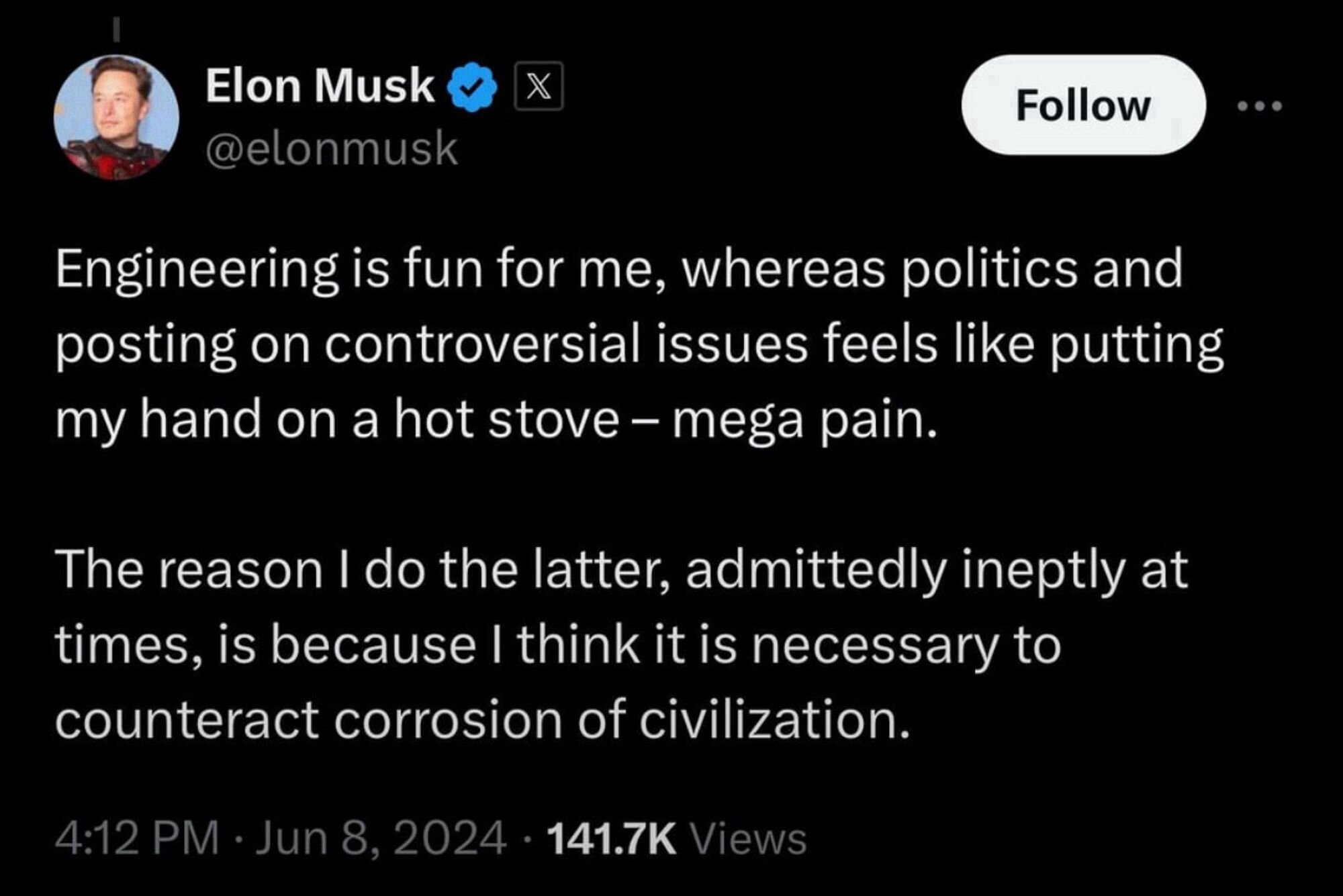
    Over the course of his testimony, Musk acknowledged his lack of restraint in posting on X and the negative impact it’s had on his company. 

    He called them “self-inflicted wounds,” a reference to his own quote in Walter Isaacson’s 2023 biography about him, though he says he hasn’t read it.

    “I certainly — I would say that I — you know, I’m guilty of many self-inflicted wounds,” Musk testified.

    Last year, Motherboard and other internet sleuths traced a bizarre account on X to Musk himself. The account, @ermnmusk, appeared to be role-playing as Musk’s toddler son.

    “I will finally turn 3 on May 4th!” one post read. 

    “I wish I was old enough to go to nightclubs. They sound so fun,” read another.

    Though the account’s name is not mentioned in the transcript, Monday’s court filing contained an exhibit of the @ermnmusk account that was shown to Musk during his testimony. In the filing, Bankston alleges that Musk deleted the account in February on the same day of the court’s discovery order.

    Asked about the account by Bankston during the deposition, Musk confirmed it was his, but dismissed it as a “test account.”

    “No, I would not use this account,” Musk testified. “It was just used for — for testing.”

    Later in the deposition, Musk again reflected on those “self-inflicted wounds.”

    “The — and going back to the sort of self-inflicted wounds, the Kevlar shoes, I think there’s — I’ve probably done — I may have done more to financially impair the company than to help it, but certainly I — I do not guide my posts by what is financially beneficial but what I believe is interesting or important or entertaining to the public,” he said. 

    A day after Brody had been falsely linked to neo-Nazis, the recent college graduate uploaded a video to Instagram begging for the harassment to stop.

    “My family and I are just being harassed completely, and I would be more than happy to clear up any confusion if necessary,” Brody says in the video. “This is just so ridiculous and I just really can’t believe this is happening to me right now.”

    Near the end of the deposition, Bankston asked Musk if he believed he owed it to Brody to be accurate. Musk said: “I aspire to be accurate no matter who the person is.”

    “Do you think you lived up to that duty to Ben Brody or do you think you failed him?” Bankston asked.

    “I don’t think — I don’t think — I don’t think he has been meaningfully harmed by this,” Musk replied.

    Bankston pushed Musk on the question, leading to another argument between the two lawyers. Finally, Musk answered, reiterating his belief that he didn’t harm Brody.

    “People are attacked all the time in the media, online media, social media, but it is rare that that actually has a meaningful negative impact on their life,” Musk testified.


    • Hook 'Em 3
  2. https://www.seattletimes.com/business/boeing-aerospace/boeings-long-fall-and-how-it-might-recover/

    How Boeing put Wall Street first, safety second ahead of Alaska Air blowout

    Spoiler

    How Boeing put Wall Street first, safety second ahead of Alaska Air blowout

    Dominic Gates

    April 7, 2024 at 6:00 am Updated April 7, 2024 at 6:00 am 

    By 

    Seattle Times aerospace reporter

    The intense backlash against Boeing after the near catastrophe aboard an Alaska Airlines 737 MAX in January wasn’t a reaction to an isolated manufacturing error but to a yearslong decline of safety standards.

    The arc of Boeing’s fall can be traced back a quarter century, to when its leaders elevated the interests of shareholders above all others, said Richard Aboulafia, industry analyst with AeroDynamic Advisory.

    “Crush the workers. Share price. Share price. Share price. Financial moves and metrics come first,” was Boeing’s philosophy, he said. It was, he said, “a ruthless effort to cut costs without any realization of what it could do to capabilities.”

    To drive down costs, Boeing chose to aggressively confront first its workforce and then its suppliers rather than partner with them. It left both, Aboulafia said, “angry and alienated.”

    Today Boeing’s leaders are tepidly admitting that this shareholders-first, cut-costs, workers-be-damned strategy was flawed. But, for two decades, it worked. 

    Boeing’s leaders delivered gushers of cash to shareholders through stock buybacks and dividends — $68 billion since 2010, according to Melius Research — rather than investing in future all-new airplanes. 

    To ensure they beat Wall Street projections every quarter, Boeing boosted the stock price with accounting tricks, such as pulling forward airline cash advances.

    Its leaders outsourced work, sold off whole divisions and discarded key capabilities such as developing avionics, machining parts and building fuselages. On the 787, they even outsourced the jet’s wings to Japan.

    They moved work away from Boeing’s highly skilled, unionized base in the Puget Sound region. They weakened unions and extorted state government with repeated threats to build future airplanes elsewhere.

    They squeezed suppliers by demanding price cuts every year that in turn forced the suppliers into ruinous cost-cutting and left them vulnerable to collapse during shocks like the COVID-19 pandemic.

    In all this, from the early 2000s on, Boeing’s leadership emulated corporate America’s then most lionized and influential boss: Jack Welch, General Electric’s hard-edged CEO in the 1980s and ’90s.

    Seattle-area Boeing employees and retirees have long complained about the negative cultural impact of the 1997 merger with McDonnell Douglas. That swept in former 25-year GE veteran Harry Stonecipher to run things, the first in a train of executive leaders who had worked under and sought to imitate Welch as cold, imperial CEOs.

    These Welch acolytes treated experienced engineers and machinists as expendable, ignoring the potential damage to Boeing’s essential mission of designing and building high-quality airplanes.

    In 1999, Fortune magazine hailed Welch as “Manager of the Century” and when he retired two years later — having transformed GE into a financial conglomerate that incidentally made light bulbs, appliances and jet engines — its stock price was flying high. 

    Likewise, Jim McNerney — who had been groomed at GE as a potential Welch successor and followed Stonecipher as Boeing CEO — retired with a $3.9 million annual pension in 2015 after 10 years leading the company, and convinced he’d left Boeing positioned for its share price to head inexorably upward. 

    It all fell apart. 

    GE’s financial engineering collapsed that company into near bankruptcy in the 2008 financial crisis. It had to sell off the light bulb and appliance divisions. The once-great American manufacturer was finally broken up completely earlier this month.

    At Boeing, five straight years of disastrous airplane design and quality problems have ripped apart its reputation as America’s premier aviation icon. 

    How can it recover?

    Executives concede strategy was flawed

    Belatedly, Boeing’s current leaders, overwhelmed by criticism, mockery and outrage since January, have finally admitted publicly that some key strategies they pursued for decades were flawed.

    “Boeing, more than 20 years ago, probably got a little too far ahead of itself on the topic of outsourcing,” Chief Financial Officer Brian West said last month.

    And in January, on CNBC, Boeing Chief Executive Dave Calhoun conceded: “Did it go too far? Yeah, probably did.”

    Both were speaking about major supplier Spirit AeroSystems of Wichita, Kan., part of Boeing until it was sold off two decades ago, part of a broad divestment of assets to please Wall Street and boost the stock. 

    Following a litany of quality lapses in Wichita, Boeing is now admitting a mistake and trying to buy Spirit back — “for safety and for quality,” said West.

    Another mistake belatedly recognized: With annual bonuses for Boeing’s factory managers based largely on meeting cost and schedule targets, it was long a cardinal sin to stop the assembly line.

    That meant unfinished jobs piled up on aircraft as they moved forward down the line, what Boeing calls “traveled work.” 

    Sponsored

    Done out of sequence, this work is more difficult and takes much longer. If too much traveled work piles up, it creates chaos. That’s what happened in Renton on the 737 assembly line.

    “For years, we prioritized the movement of the airplane through the factory over getting it done right, and that’s got to change,” West said. “Once you reduce traveled work, your quality gets better.”

    Even the overarching commandment at Boeing until now — boost the share price — appears no longer sacrosanct.

    Speaking of how Spirit might be fixed, West said: “It’s really about focus and running it, not as a business, as a factory. Run it as a factory and stay focused on safety and quality and stability.”

    Yes, that is Boeing’s CFO saying business considerations now need to be lower priority in the jet-making operation.

    “There’s a lot of change happening at Boeing right now,” West said. “It’s a hard moment.”

    Ron Epstein, a financial analyst with Bank of America with a doctorate in aerospace engineering, is not impressed.

    Before the panel blew off the Alaska jet, “everything from management’s point of view was going just swimmingly. They had no idea what was going on on the production line,” Epstein said. “It took almost a catastrophic accident to shake things up.”

    “Darth Vader” as CEO

    Adam Pilarski, veteran aerospace analyst with consulting firm Avitas and former chief economist at Douglas Aircraft, said in an interview that former CEO McNerney must take “a big share” of the blame for Boeing’s decline.

    Aggressively anti-union, McNerney sited a new 787 assembly line in nonunion South Carolina. Then in 2014, he finally forced Puget Sound area Machinists to give up their pensions with threats to build Boeing’s next big widebody jet, the 777X, in another state. 

    Later that year, he joked about employees “cowering” before him.

    Pilarski said this came from “the GE mentality … not thinking about long-term relationships.” 

    “If you have bad relations with your workers you can’t expect loyalty and great performance,” he said.

    A former senior executive at Boeing — who is now retired and asked not to be identified criticizing former colleagues — said that even though Boeing has “the best aerodynamicists and engineers in the world … and the mechanics have done an extraordinary job over the years,” both Stonecipher and McNerney “made the workforce into adversaries.”

    In 2013, McNerney, acknowledging that “I’m sounding like Darth Vader here,”
    touted plans to reduce costs both by slashing jobs across Boeing and by squeezing its suppliers hard.

    “If a certain group is not working with us … they’ll be on a no-fly list,” McNerney said of his suppliers. “They’ll not be allowed to bid on new programs.”

    Forced to cut their own profits to raise Boeing’s, angry suppliers were damaged. Spirit AeroSystems, in dire financial straits last year, revealed that it had lost on average over $1 million on every 787 section it had built for Boeing since 2007.

    Spirit builds the forward fuselage of all Boeing commercial jets and the entire fuselage of the 737 MAX. It has in the past two years delivered defective 787 fuselage sections and a series of MAX fuselages with various serious defects. 

    After all the squeezing on price, Boeing had to bail Spirit out financially last fall.

    Another thread in Welch’s GE strategy was a reluctance to spook investors by risking money on expensive long-term projects. Announcing such big financial commitments immediately dents the share price.

    So in 2014, McNerney declared that Boeing must do more with fewer resources and would take no more “moon shots.”

    “Every 25 years a big moon shot … and then produce a 707 or a 787,” McNerney told Wall Street analysts. “That’s the wrong way to pursue this business.”

    Instead, Boeing would move forward incrementally, adding new engines to the 737 and thus developing the MAX instead of a much more expensive all-new jet.

    In fact, though, big expensive development projects that produce a payoff only years later are the very nature of the airplane-making business. 

    Every new jet program is a financial leap. If a company wants to stay in the airplane business, it has to make the leap. 

    And Boeing’s primacy in the industry was built on revolutionary leaps, such as the 707 and 747. 

    “In aviation, you do need moon shots,” said Pilarski.

    Welch’s success while at GE inspired a generation of business school courses and MBA graduates. But in an ethics course this semester at the University of Washington’s Foster School of Business, a case study of Boeing’s decline produced a reassessment.

    Tod Bergstrom, who taught the Boeing class, said that as the 150 students who took it go out into the business world, he thinks they “will be highly skeptical of Welchian management techniques.”

    “They really had their eyes opened to a fascinating and ultimately sad trajectory in the last 25 years” at Boeing, Bergstrom said.

    The legacy Boeing culture 

    Longtime legacy Boeing employees offer a glimpse of how the company culture changed.

    Stan Sorscher worked as a physicist at Boeing and later as a research analyst for the white-collar union, the Society of Professional Engineering Employees in Aerospace. He describes with passion the engineering culture that Commercial Airplanes CEO Alan Mulally created in the 1990s to develop Boeing’s last successful airplane program, the 777.

    Boeing engineering and manufacturing groups, along with teams from suppliers and customers, worked together to solve problems on the project, each ready to make sacrifices for a better overall outcome.

    But on the next all-new Boeing airplane, the 787 Dreamliner, a different development model took hold, with suppliers doing much of the detailed design work. Originally, only the tail fin was to be made by Boeing.

    Instead of the 777’s collaborative engineering culture, Sorscher saw Welch’s top-down management approach come to Boeing. He called the 787 a “shoot-the-messenger program.”

    Engineers who raised technical doubts were told: “Follow the plan. If you can’t do your job, I’ll fire you and get someone who can.”

    The new approach created rivals rather than partners. Both suppliers and Boeing employees were made to “feel contingent, and precarious, and at risk. That they had a rival who could come in and take their job,” Sorscher said.

    Boeing long ago conceded that developing the 787, its introduction delayed by years, was an operational and financial disaster.

    Phil Chandler, a highly skilled machinist at Boeing for more than 42 years before retiring when COVID hit in 2020, in the last two decades of his career noted the same dictatorial approach on the factory floor.

    “People who knew how to build an airplane were viewed as roadblocks. They slowed things down,” said Chandler. “The only word you could speak to executives was ‘yes.'” 

    Whereas in the past, first-level and even second-level managers in the factory had come up through the ranks as mechanics and had deep knowledge of the work, after Stonecipher came in those jobs shifted to white-collar people with degrees, often with MBAs.

    However smart those managers were, it took around 18 months for them to really learn how the operation worked, and they were moved to another position typically every one or two years, said Chandler.

    “They were never allowed to stay long enough to become effective,” he said.

    Analysts project it will take considerable time for Boeing to restore its culture and regain anything like its former glory.

    “Boeing’s delivery volumes are unlikely to catch up to Airbus this decade,” Melius Research analyst Rob Spingarn told investors at the end of March. “If Boeing does not launch a clean-sheet aircraft, it may not catch up to Airbus in the 2030s either.”

    Steps toward recovery

    Calhoun is hobbled by ongoing regulatory and criminal investigations and will leave by year end. What can his replacement as CEO do to begin a recovery?

    Any recovery relies on Boeing’s employees believing the company has a future and pulling together to achieve it. 

    The pandemic decimated the ranks of experienced employees. Building back up and retaining the workforce is critical.

    But data compiled by a company engineer shows a serious drop in Boeing salaries relative to inflation and the general rise of salaries in the Seattle region, a decline confirmed by SPEEA.

    In 2013, middle-rank engineers at Boeing were earning 159% of the median household income for the metro area, the data shows. Ten years later, the same Boeing salary was down to 114% of that level.

    “I’m getting squeezed more and more,” said the engineer, who asked not to be identified so as to avoid retaliation. 

    If the relative value of his salary continues its slide, he said he’ll reluctantly think about relocating or leaving Boeing to get a job in tech.

    The increased cost of raising salaries can hit the share price. Still, Boeing will certainly have to raise wages significantly for the blue-collar Machinists to avoid a strike when their contract expires in September.

    “Boeing has to give the IAM just about everything they ask for,” said the former senior Boeing executive. “You’ve got to get the IAM on your side.”

    Aboulafia agrees, saying management should approach the Machinist negotiations with a genuine sense of mutual interest: “Let’s save the company together.”

    In addition, Boeing’s leadership must begin to look ahead, to speak publicly about building the next all-new jet and advancing technology to decarbonize aviation. 

    Even if the launch of such a plane is years away, present it as a vision, as a moon shot, said Pilarski of Avitas. 

    “Talk about it to your employees so they get excited and start believing in your future,” he said. “That element has been missing for quite a long time.”

    Epstein is optimistic that if Boeing reaches for that future, it will recover.

    “Airplanes connect the world. It’s just a cool industry to be part of,” he said. “It shouldn’t be that hard to attract people to what they do. Now just keep them compensated, happy, energized.”

    Still, visionary talk from the top is not going to be enough. 

    To convince employees they have a personal stake in the company’s future, there are two expansive gestures Boeing’s leaders could make near term.

    The first: Move Boeing’s headquarters back to Seattle.

    That would be symbolically powerful and to industry observers is logical. 

    The move to Chicago in 2001, orchestrated by then-CEO Phil Condit and Stonecipher, served only to distance the leadership from Boeing’s workers. 

    The relocation of the headquarters to Arlington, Va., in 2022 proved the Chicago move a failure, and equally makes no sense for Boeing’s main business.

    “Seattle is the capital of aviation in the U.S.,” Pilarski said.

    “You can’t run Boeing from the East Coast,” said Bank of America’s Epstein.

    The second: An advance commitment from Boeing to build that next all-new jet in its Puget Sound region factories, with significant secondary work allocated to North Charleston, S.C.

    “Tell the [workers] who know how to produce planes, who have been doing it for decades, that no, we’re not moving everything to a totally different place,” Pilarski said. 

    For many years, Boeing’s leadership has steadfastly refused to offer such a promise to its workers. If the jet maker is to recover from the current crisis, is it time?

    Dominic Gates:  206-464-2963 or dgates@seattletimes.com;  Dominic Gates is a Pulitzer Prize-winning aerospace journalist for The Seattle Times.


    • Hook 'Em 3
    • Like 1
    • Rage+1 1
  3. Brisket and lamb tacos from Yellow Bell Tacos, imo. It’s the same guys who run Interstellar BBQ. And crispy dogs.

    IMG_5945.jpeg

    IMG_5946.jpeg

    • Hook 'Em 3
    • Like 1
×
×
  • Create New...